RfP: Aviation EU External Evaluation
Climate CatalystClimate Catalyst’s Aviation Programme - End-Term Evaluation
Reports to: Senior Head of Network Learning and Innovation
Preferred timezone: Based in Europe
Budget: € 30,000 - 39,000 (inclusive of all taxes, fees and expenses)
Contract: Fixed-term assignment, Oct 2026 - March 2027 (final dates subject to contracting).
About Climate Catalyst
Climate Catalyst is a non-profit dedicated to galvanising the collective power of business, investors, and civil society to influence and accelerate policy change in Asia and Europe. We work to strengthen collaboration and mobilise new actors on pivotal climate challenges to build power and compel political leaders to act at the speed and scale needed to tackle the climate crisis.
Our Aviation programme aims to enable narrative change and private sector action to tackle aviation’s climate impacts in Europe. As the programme approaches its close in March 2027, an independent external evaluation will provide credible, externally validated evidence of what was achieved, assess the resilience of those achievements, and generate transferable learning for future work. The evaluation is not intended to inform ongoing programme delivery; its primary purpose is to support a rigorous and well-evidenced closure of the programme, including partner feedback and a detailed assessment of impact achieved.
Climate Catalyst is seeking proposals from qualified firms to design and deliver an independent end-term evaluation of its Aviation programme in Europe. This Request for Proposals sets out the background, scope, deliverables, qualifications, submission requirements and assessment criteria for the assignment. This is an open invitation to firms with demonstrated experience in impact evaluation, particularly for NGOs.
Purpose and Objectives
- Assess evidence of impact across all current and past programme levers including narrative change and private sector action.
- Capture and evaluate ecosystem coordination, narrative shifts, and influence-related changes, alongside more direct programme outputs and outcomes, as the Aviation programme is a systems-level programme.
- Generate credible, independent evidence of results to support ongoing donor engagement, strengthen partner relationships, and validate the programme’s theory of change.
- Build internal evaluation capacity within the Climate Catalyst team by making evaluation design, methods, and analytical reasoning transparent and participatory throughout the process, enabling staff to apply similar approaches independently in the future.
The evaluation will specifically address:
- Measure and define the impact: What impact has the European Aviation programme had?
- Did the programme contribute to real-world change, as defined by its impact ladders and OKRs? Did the programme deliver its intended outputs and outcomes? This includes how outputs and interventions have been perceived and valued by stakeholders, and (subject to discussion during proposal review), what contribution the programme has made to emissions reduction pathways in the aviation sector.
- To what extent has the Aviation programme contributed to shifts in the EU/UK policy landscape for sustainable aviation? To what extent do these shifts represent steps forward on ambition, or in mitigating the impact of rollbacks?
- What evidence exists that the programme influenced the wider narrative around aviation within civil society, and among policymakers, media, and the public?
- How has the private sector action work (targeting e-fuels companies, incumbent fuel makers, institutional investors and banks) shaped awareness, knowledge, and behaviour related to aviation decarbonisation and sustainable aviation fuels?
- To what extent have civil society partners strengthened their capacity and confidence to advocate and communicate strategically on aviation climate issues?
- Assess evidence of strategy and tactic effectiveness: Which strategies and approaches worked well, and why?
- Which activities proved most effective in influencing the European aviation policy environment or private sector knowledge/behaviour, and under what conditions?
- What was the programme’s distinctive contribution compared to other actors working on tackling the climate impacts of aviation in Europe?
- How could the durability of any programme achievements be enhanced?
- What legacy has our programme activities been able to leave or unlock?
- Produce learning for future programmes: What would we do differently? What could or should others replicate?
- Which assumptions in the theory of change proved most and least valid? What are the implications for future work related to those assumptions?
- What does the programme’s experience reveal about the role of private sector action, strategic communications, research, strategy co-design, network building, and policy advocacy in driving change?
- How did the programme adapt its strategy in response to shifts in the political and wider external environment?
- What should the programme team do differently, and what are the transferable lessons for other programmes?
Scope of Work
- Co-design the evaluation framework with Climate Catalyst, including a working session that explains the rationale behind methodological choices.
- Gather and synthesise qualitative and quantitative evidence of impact, including from individuals and organisations engaging with our programme outputs. This should include synthesis of what the programme started, contributed to, delivered and achieved, including an assessment of policy resilience and longevity.
- Conduct a ‘listening report’: structured engagement with programme partners and stakeholders (industry, financial institutions, civil society, researchers, philanthropies) to capture perspectives on programme relevance, effectiveness, and influence. This should gather evidence of what Climate Catalyst achieved and how it was perceived by those it worked with, to be used in communications materials about the programme.
- Assess where the policy landscape remains contested at programme Close: the evaluation should assess the extent to which the programme has increased the likelihood of positive policy developments, or contributed to mitigating worse outcomes, and whether the right actors are in place to continue the work.
- Produce a final report summarising evidence of impact of the Aviation programme.
Required Qualifications and Experience
- Demonstrated experience in programme evaluation in advocacy, policy influence, or civil society contexts, ideally in climate or energy transition.
- Strong mixed methods research skills, including stakeholder interviewing, and experience with contribution analysis or similar approaches to attributing policy influence.
- Ability to assess the resilience and longevity of policy outcomes, not just whether change occurred, but how durable it is.
- Familiarity with theory of change approaches and the ability to interrogate assumptions critically and constructively.
- Experience assessing narrative change, eg.media analysis and social listening, is desirable.
- Excellent written English and ability to translate complex findings; ability to produce clear, credible, evidence-based reports for donor and partner audiences.
- Ability to work in a participatory and capacity-building oriented way, making methods and reasoning transparent to internal teams, not just producing outputs.
- Ability to assess and provide estimation or quantification of the emission reduction and/or climate impact of the programme is desired but not required.
Compensation + Benefits
- The budget for this assignment is € 30,000-39,000, inclusive of all taxes, fees and expenses.
Proposal Requirements
To be considered, please submit the following:
- Technical Proposal (maximum 4 pages)
- Demonstrate understanding of the assignment and proposed evaluation approach and methodology
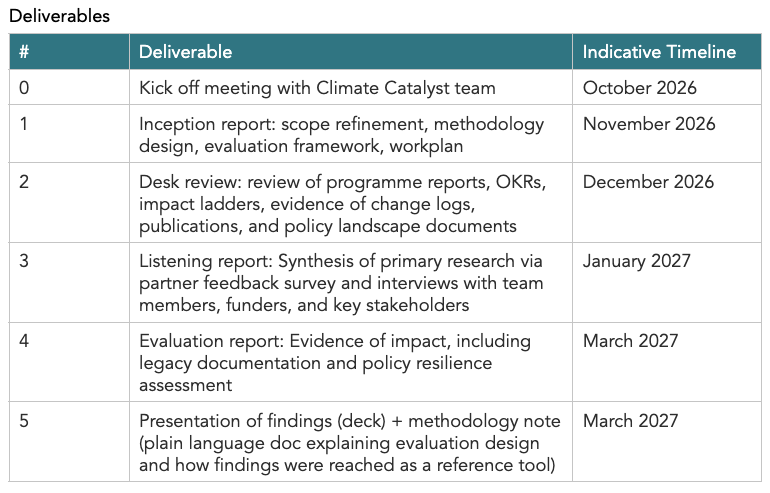
- Include workplan and timeline mapped to the timeline and deliverables indicated in this Request for Proposals
- Outline how the firm will work in a participatory, capacity-building way with the Climate Catalyst team.
- Team information
- A short profile of the proposed team composition, including legal status and registration. Include CVs of lead personnel and their roles on the assignment.
- At least two examples of comparable assignments and two client references
- Financial proposal
- All-inclusive budget within the stated ceiling
How proposals will be assessed
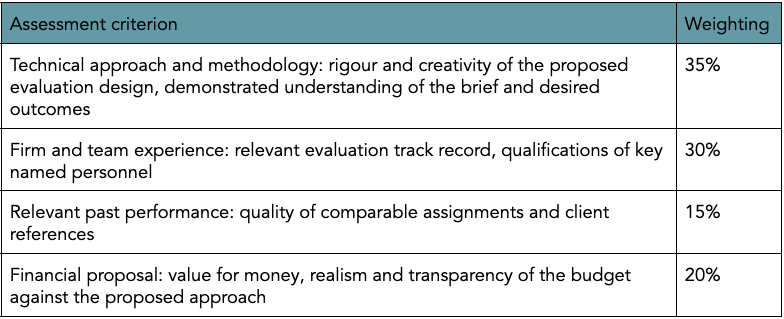
Proposals will be evaluated on a combined technical and financial basis using the weighting below. Shortlisted firms will be invited to interview before a final decision is made.